About
Most people with my résumé stopped designing a decade ago.
I ran product and design organizations for eight years — teams of thirty, roadmaps that carried a company past a $3 billion valuation. Then I went back to doing the work myself, because that's the part I'm best at and the part I actually enjoy.

The short version
I can do the work, and I can build the team that does it.
The old line is that those who can't do, teach. I've spent twenty years doing both.
I've designed the flows, drawn the wireframes, built the design systems, and shipped the interfaces. I've also hired the designers, written the growth paths, set the research standards, and owned the roadmap that all of it served.
Most consultants have done one of those. Most executives stopped doing the other years ago. The reason I'm useful is that I never stopped moving between them — I know what a decision costs to build, what it costs to maintain, and what it does to a number somebody has to report at the end of the quarter.
That shows up in what I hand over. On one engagement it was mockups, usability testing, and then a document of epics and user stories written so the client’s product owners could drop them straight into their backlog. Most designers hand over a Figma file and leave the translation to someone else.
When a project needs something outside my range — motion, illustration, front-end build, research at volume — I bring in people I've worked with before. What doesn't change is who's doing the design.
Origin
I've been rebuilding brands for new mediums since I was seventeen.
I could always draw. For a while I wanted to be an architect, which is what people told me to do with that particular skill.
What actually happened was the dot-com boom. I was seventeen, building websites by hand and learning early versions of Photoshop, and I spent my senior year of high school working for a company selling $9.99 dial-up internet in my hometown. Local businesses needed websites. I'd take a yellow page ad or a business card and build the site from that.
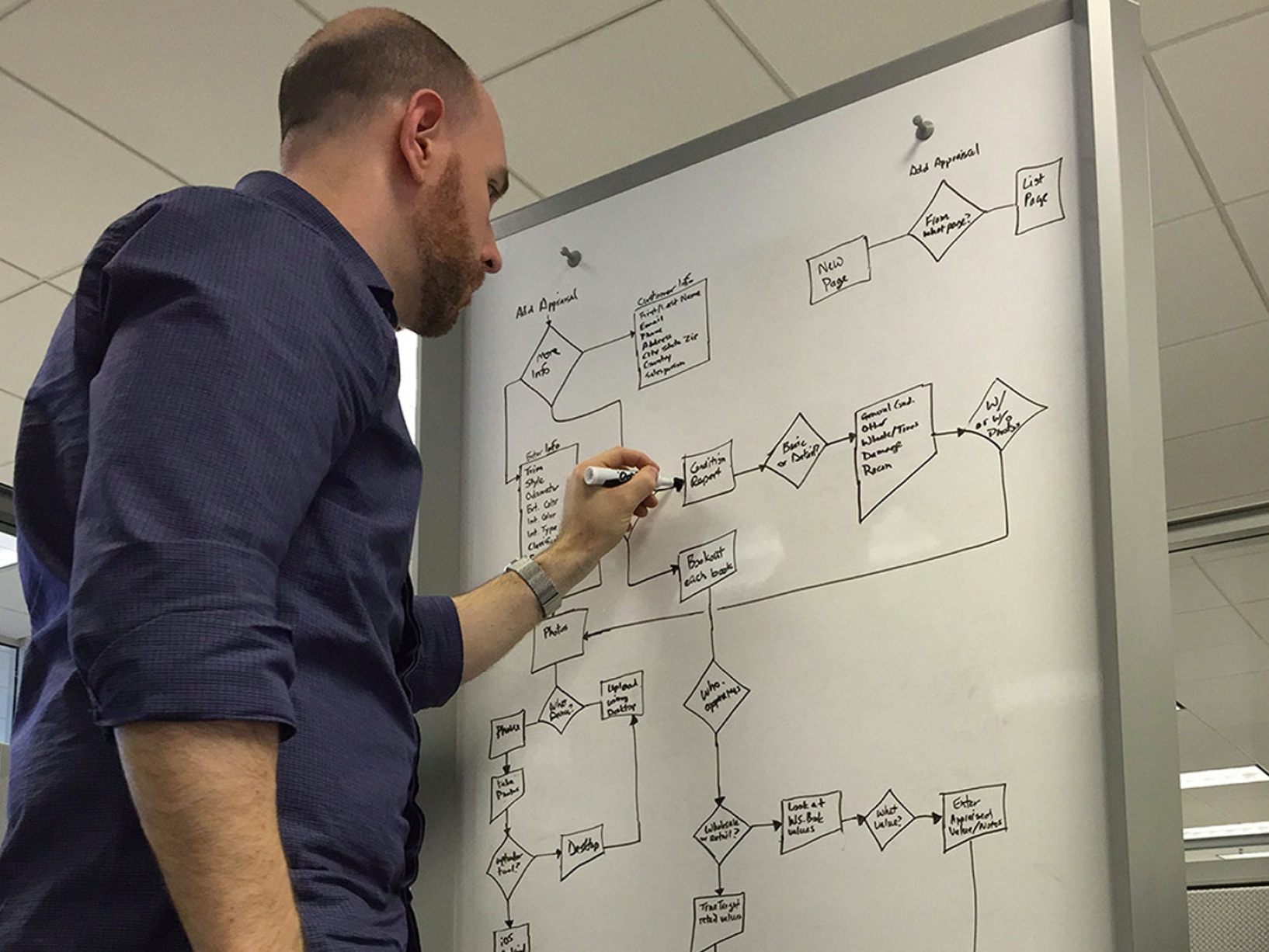
That's still the job. Something exists in one medium and has to work in another without losing what made it recognizable. I've been doing versions of that ever since — logos and brand collateral for companies and a university, templates and custom assets at an ad agency, and eventually product interfaces.

Then I watched software get used in the wild.
I left the agency for an automotive startup — restructuring their platform for scale, designing client websites, building templates for the internal software, and helping the sales team figure out how to price the work we were doing. The company grew and was acquired.

The part that changed my career was watching people at dealerships use the software. I could see the whole picture and the small details at once — how a screen worked, and what it was doing to customer satisfaction, revenue, and retention. Some interfaces I'd designed ended up in a presentation deck, and I was asked to move to the software side as a Senior UX Architect.
That's where the way I work now comes from. Design is a business decision. I learned that by watching one get made badly.
The pattern
Every job turned out to be the same job.
Nine years in automotive, then health and safety. Different industries, different products. In every one of them I ended up doing the same four things — establishing process, building teams, documenting how the work gets done, and rebuilding platforms so they could scale.
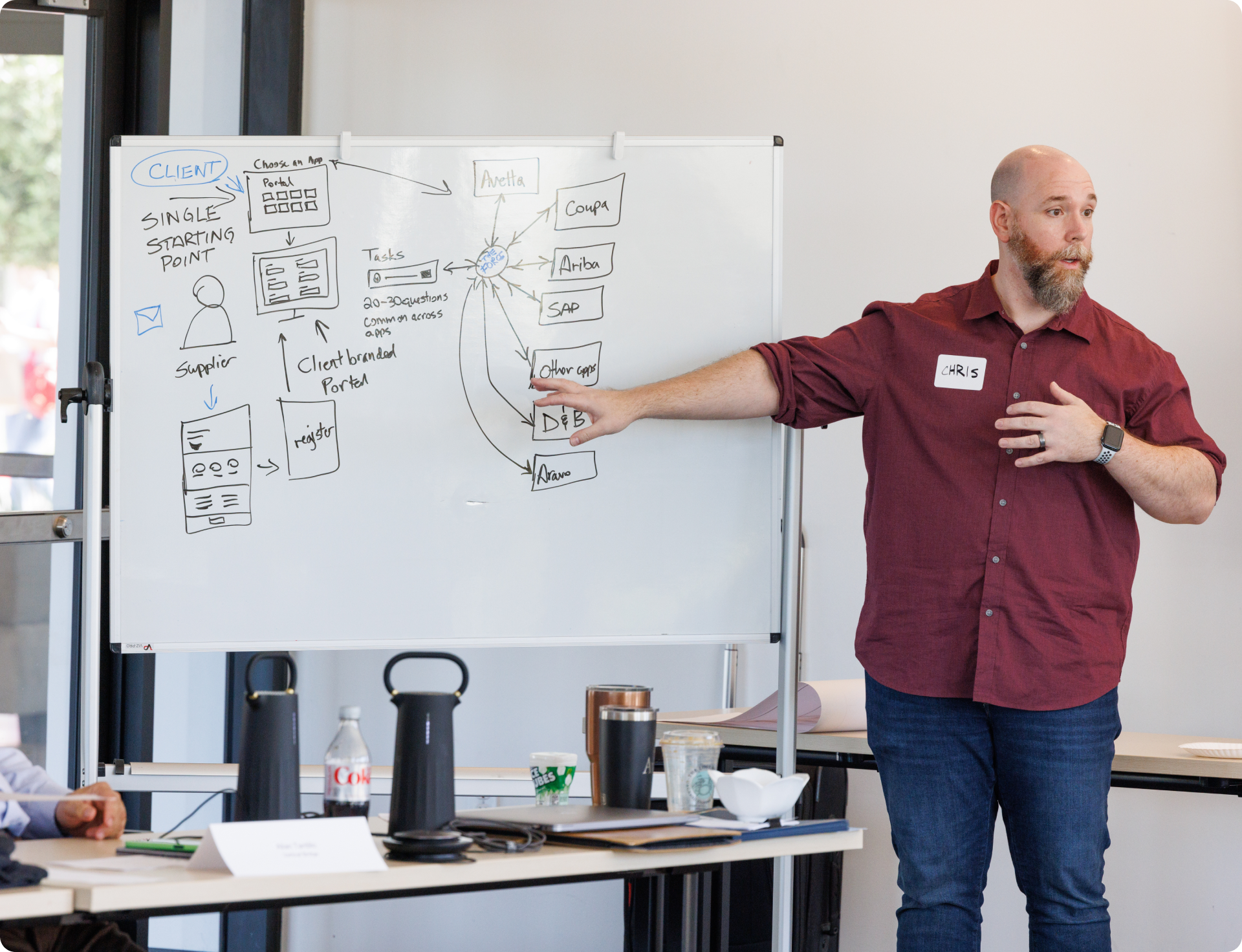
That's why Avetta hired me. They needed exactly that, and I'd done it enough times to know where it goes wrong.
- $1.5M
- Cut in annual design spend
- 20+ yrs
- Across product, systems, and brand
- 3
- Disciplines I can speak to directly
Two of us replaced a six-person external UX team, because we shipped faster
Automotive, health and safety, data infrastructure, nonprofit
Product, UX, and front-end development
I came in as a Principal Product Designer. Between myself and one other designer, we replaced a six-person external UX team and took $1.5 million a year of outside design spend off the books — not by working cheaper, but by being faster and hitting product goals sooner.
I could do that because I speak product, UX, and front-end. Nothing had to be translated between three groups of people before it could get built.
How I operate
Six things I hold myself to.
Not aspirations. The standard I work to, and what you can hold me to.
-
People over process
Outcomes over ceremonyProcess matters. Outcomes matter more. Structure should speed a decision up, not slow it down.
-
Don't settle for good
Craft“Fine” ships. “Better” wins.
-
Everything speaks
ConsistencyWhat ships and what gets tolerated set the standard. Details build trust or erode it.
-
Measure what matters
EvidenceSuccess gets defined before the work starts and checked after it launches. Opinion doesn't beat evidence.
-
Say it early
CandorBad news doesn't age well. If something isn't working you'll hear it from me before it gets expensive.
-
Show the work
Bias to buildDeliberation happens early. After that, I'd rather show you something than describe it.
Leadership
I knew there was a better way to manage people, so I went and did it.
I always knew I was a leader, and I wanted the responsibility. Avetta gave me the opportunity and it grew into a team of fifteen people reporting to me, inside a product organization of about thirty.
I'd worked for enough leaders by then to have opinions. There was a better way to treat people, and a better way to reward them. If I was going to manage anyone, the point was to help them become a better version of themselves.
Every person who reported to me was still at Avetta when I left, and every one of them had moved up. The ones who eventually went elsewhere left for bigger roles than the ones they had.
The processes, the growth paths, and the design system are all still in use. The org is still there, and so is the playbook.
The measure of managing people well isn't what they produced for you. It's where they ended up.
That experience is why advisory work is part of what I offer now. Not because I want to run someone else's department — because I know what it takes to grow a designer, and most teams don't have anyone with the time to do it.
In the numbers
A decade of it, at scale.
- $3B
- Company valuation the roadmap ran through
- $285M
- Annual revenue owned — up from $100M
- ~30
- People in the product org I helped build
- 192
- Major initiatives shipped in 2021
- 8 yrs
- Leading product and design at Avetta
- 15
- Designers & PMs grown, then promoted
The record
For the people who want the receipts.
Eight years of it, most recently as Senior Director of Global Product Design.
- Owned product discovery for the roadmap through a company valuation past $3 billion
- Owned the Avetta Design System — Figma and codebase, documented and componentized across all products
- Built an acquisition scorecard measuring UX maturity of acquired organizations
- Authored the company's first brand guidelines
- Led strategy for a new website: views +171%, sessions +189%, organic traffic +135%, qualified leads +58%
- Owned the roadmap for all products through revenue growth from $100M to nearly $285M a year
- 60% increase in roadmap delivery via a prioritization value matrix — 192 major initiatives shipped in 2021
- Grew the team from one project manager to nearly thirty product managers, owners, designers, and researchers
- Established talent acquisition and growth paths for every product role
- Cut $1.5M a year in third-party design spend
- Built Neptune, the design system behind Avetta Connect
- Project lead for discovery, design, prototyping, and testing of Avetta Connect
Earlier
Education
BA, Applied Technology and Performance Improvement — University of North Texas
Certified SAFe® Product Owner / Product Manager · Certified Scrum Product Owner
Off the clock
A few things that aren't design.

This is my best friend. My wife.
It wasn't love at first sight. But I eventually stole her heart. Together we're unstoppable. Separate, we're average.

Guitar, and a Les Paul.
My dad, Peter, was a film composer. When I was young I heard the tone of a Les Paul during one of his recording sessions and that was that.

Hockey and baseball.
The Dallas Stars, win or lose. And the tough part of being both a Dodgers and a Rangers fan.
I won the 2001 24 Hour Video Race.
Twenty-four hours to write, shoot, and cut a short film. We won. It's the oldest evidence I have of doing good work fast under a hard constraint.
Work together
If your design problem is bigger than it looked from the outside, I've probably seen it.
Tell me what's going on. If I'm the right person I'll say so, and if I'm not I'll tell you that too.